
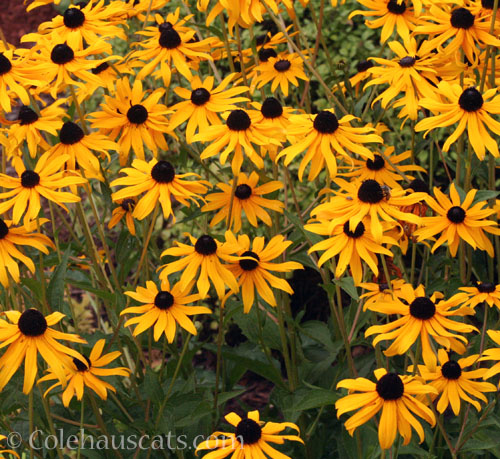
Say hello to the dry summer hold outs. While we haven’t had the scorching hot temperatures everyone else had this summer, we didn’t go into summer with a lot of water due to our dry winter. So, while it wasn’t terribly hot, it was, and still is, terribly dry. Some things didn’t grow as well as last year but then again, Mom did transplant a LOT of things last spring and that always slows things down.
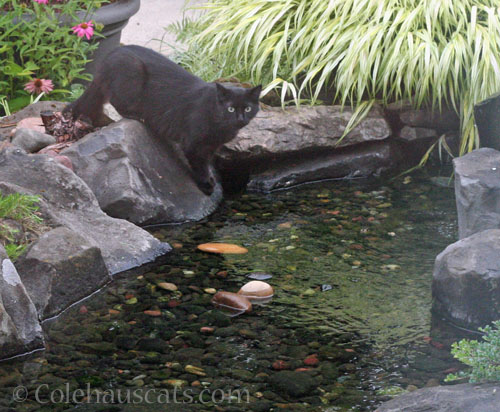
Doesn’t look dry to me, says KeeKee, a visiting neighbor cat. Oh, you can trust us, KeeKee. It’s dry all right.
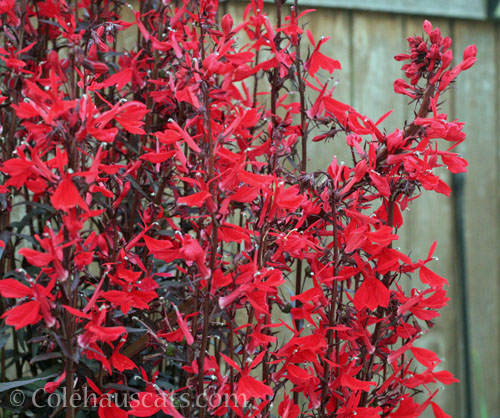
Still, it was a pretty show out there following a spectacularly flowery spring. Other than the occasional visiting cat and chittering baby raccoons tearing up stuff in the middle of the night, the hummingbirds, and most all our usual visiting birds ruled the back yard.
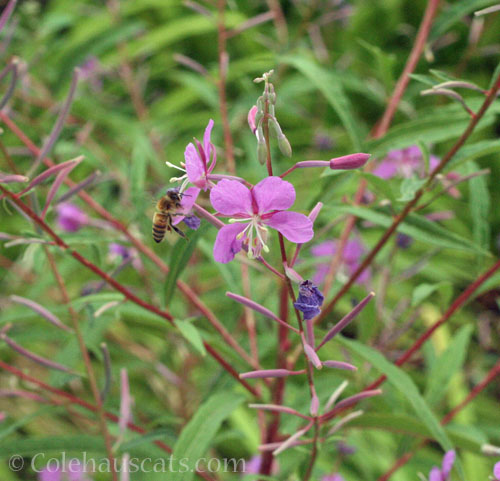
This pretty purple flower with its bee buddy is called Fireweed. For years, we thought it was an invasive tall phlox and ripped out most of the underground roots. And as usual, Mom couldn’t bring herself to completely rid the side yard of it. She says, “But it tries so hard to survive.”
Turns out, it’s Fireweed and a very important flower to pollinators. From a quick Google search for Fireweed: “Fireweed (Chamaenerion angustifolium) is a tall, hardy perennial plant famous for its bright magenta-pink flowers and its ability to rapidly colonize scorched or disturbed land. It serves as a vital ecological pioneer across the Northern Hemisphere. Provides heavy nectar sources for bees, butterflies, and hummingbirds, and serves as food for large mammals like moose and deer. Often viewed as an inspiring symbol of ecological recovery, resilience, and nature returning after destruction.”
It was also the first plant to recover and bloom at the site of Mt. St. Helens when it blew up back in May 1980. Before our backyard neighbors planted tall cedar trees and blocked the view, we could see Mt. St. Helens from our upstairs windows. And since Mom’s a closet science dork who remembers exactly where she was that eruption day, she’s very happy she didn’t kill this poor plant who was just trying to survive after all.
We’ll let you know if any moose wander by for a snack.
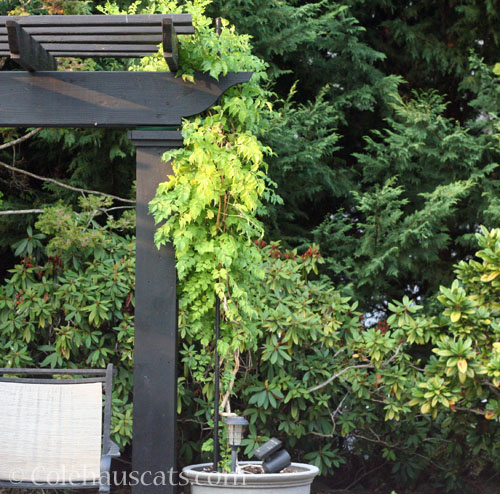
The donated-to-us Trumpet Vine has finally reached the top of the arbor. A little slower than we figured it would but then again, it was cut back hard upon arrival here because it was woefully misshapen and not allowed to bloom. We think next year will be it’s first bloom year. Mom has secured it well to the arbor post and its ready to finish out the season.
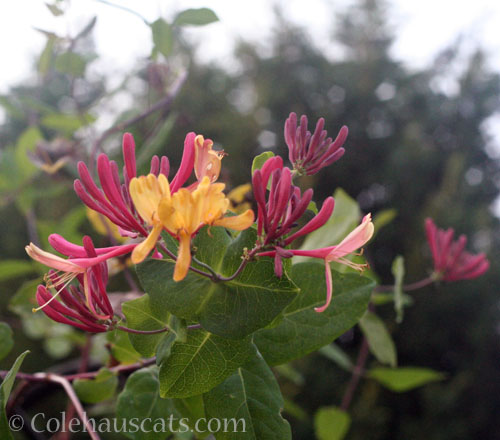
Another vine, this time politely hanging over the fence, is a honeysuckle, a.k.a. hummingbird magnet. There’s nothing quite like attempting to go into the back yard and getting heavily scolded by a couple of flying darts hummingbirds who are fighting over flowers.
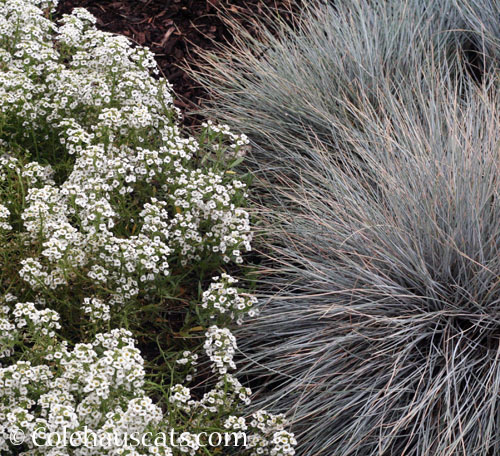
Here’s the 4th generation “annual” moisture-loving white alyssum snuggled up against one of the dry weather loving blue grasses. These are so opposite – one like moist soil, the other dry and yet, they get along just fine. We might want to take a hint and try that someday. We’re calling the alyssum 4th generation because they keep reseeding themselves while the main plant never quite dies. 4 years is pretty old for an annual.
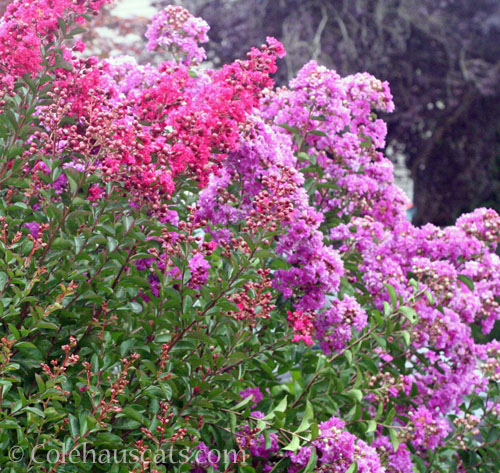
A long, long time ago, our dwarf Crepe Myrtles used to be the very last thing to bloom in fall, often late September into early October. That was before drought crept into the Pacific Northwest. Here it is the end of August and these are just about done blooming for the year. Luckily for us, we still have one plant that take us into cooler fall weather and it doesn’t even have buds yet.
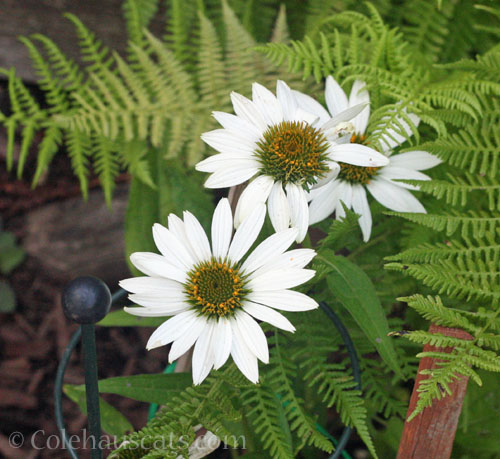
Long time Colehaus Cats readers might remember the summer Mom became obsessed with white Coneflowers. She saw a display in a newly developed area way across town and promptly hunted down and bought 3 plants.
Well, the raccoons dug every one of those up, repeatedly, and only 1 survived. And Mom will tell you it’s doing great! That barbed, electrified wire really did the trick! <—- KIDDING!! Though just barely. Mom surrounded that lone plant with ten sturdy flower stakes and wrapped those with a ridiculous number of thick wire ties. And it was only dug up one this past spring! We’ll take that as a win.
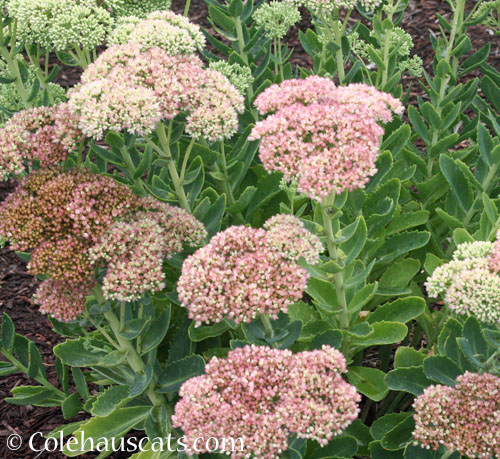
Another early flowering for this sedum that used to bloom in late September/early October. Mom used to have 5 different clumps of this plant throughout the yards. Finally, she’s pared it down to one good clump. Beware, kids. Gardening can become addictive!
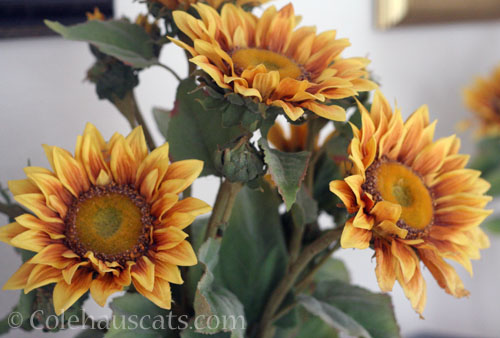
Because we can’t really bring many flowers indoors, we set out a pot of fake, fake, FAKE sunflowers during late summer and you know what? Cats will still attempt to chew on them. Quint, ‘fess up. We know it was you.

I cannot tell a lie. Yes, I tried, once again and again like every summer, to chew off the thick, friendly plastic leaves. That’s what I do. I chew friendly looking things. If not a friend, why friend shaped? And why so tasty?
Only you would find a plastic FAKE leaf tasty, Quint.
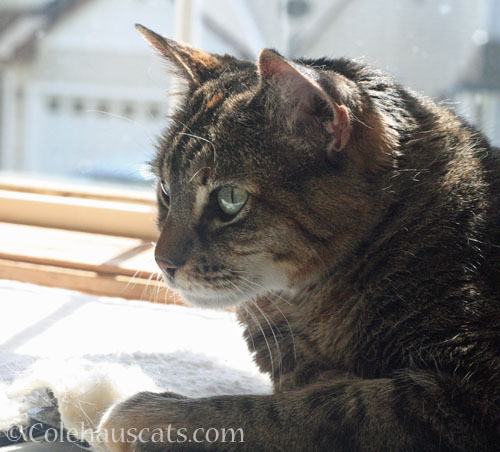
Here’s a thought: Maybe all the leaves outside taste like thick, friendly plastic too. You could have a feast out there, big brother.
We don’t need any comments from you, Viola.
Thanks for visiting us and our garden today. Have a good weekend!
~ ~ ~
A Colehaus Cats flashback:
2025 – No post
2024 – No post
2023 – Checking up with Olivia
2022 – No post
2021 – A Random August post
2020 – No post
2019 – Art in August, Cat-Style
2018 – No post
2017 – Monday News with Teese
2016 – No post
2015 – Friday Flashback Fun
2014 – No post
2013 – Still Life
2012 – No post




Lovely flower images, and Quint, you are an original!
keekee….look for fizh buddy 🐟🐟‼️‼️ N guyz…pleez ta tell yur mom thanx for sharin her gardin with uz…we haz said it bee for N will say it all R dayz…itz de coolezt gardin that side oh that long river….me N de gurl troo lee N joyz de toor…stuffz bee a fried heer…leevez even bee fallin off treez all reddy 🙀.hay, happee week end two ewe all 💚‼️😸🐾
Your yard is beautiful. You could charge for tours. Most of my cats would eat the fake flowers too. 🙂 XO
Everything looks so pretty! I especially love the Crepe Myrtles.
Wow, everything is blooming so nicely at Colehaus. Quint, maybe Mom Cole can get you some fake flowers that taste like chicken or something.